Here comes the FOURTH QUARTER!
Are you ready for the fourth quarter. Plan now. Realistically, there are only seven productive weeks left in this calendar year. Take a look at maintenance issues and what you will be doing to be ready for 2015.
As you forecast the goals and objectives of the coming year, consider how Indoff can assist you in reaching the goal. Not sure how. Give Indoff a call.
Personnel Grounding by Transforming Technologies
ESD Personnel grounding
People remain as the main culprit contributing the most in destroying the sensitive electronic chips used in electronic equipments and gadgets. Because of this reason, ESD Association established an ANSI/ESD S20.20 standard to provide guidelines to organizations across the globe on the protection of their ESD sensitive items from ESD damage greater than or equal to 100 Volts Human Body Model (HBM).
When a person walks, electrostatic charges continuously build up on the person body through the contact and separation process that takes place between the person’s shoe sole and the flooring material.
The electrostatic charges start to discharge from the person when he touches a conductive material. That explains the reason why a person would feel a jolt when he touches a conductive door knob in a cold and dry weather. Static jolt is felt when static electricity of at least 3000 Volt build up in a person body. But a mere 10 Volts can kill a Tunneling Magnetoresistive head(TMR)straight away without the
person knowledge.
In any organization, ESD personnel grounding are given the most attention.
There are common ways where ESD personnel grounding are controlled:
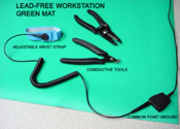
- Wearing an ESD wrist strap
- Wearing an ESD shoes
- Using ESD floor mats
- Using ionizing equipment
Article credit given to: Transforming Technologies, LLC , Toledo OH

Coming soon ESDA Symposium 2014

2014 EOS/ESD Symposium & Exhibits
Students wishing to receive the student discount
must provide proof of student status (i.e. copy of Student ID Card)
to info@esda.org prior to completing online registration.
When
Sunday, September 7, 2014 - Friday, September 12, 2014
8:00 AM - 5:00 PM
Pacific Time
Where
Westin La Paloma Resort
3800 East Sunshine Dr.
Tucson, Arizona 85718
USA
1-888-627-7201
Sponsor
The Ergonomics Response

Project case: How to Set Up an Ergonomic Workplace (from www.sovella.us white papers)

How to set up an ergonomic workplace
Why usability and ergonomics improvements?
Because industries recognize work related health problems and associated costs, they look for working environment solutions designed to fit workers’ needs. The goals are to enhance comfort and satisfaction while maximizing worker efficiency. Considering usability and ergonomics in product development processes has financial and social advantages for all concerned.
Sovella uses scientific research to design workplaces

Sovella -- a pioneer in the manufacturing of industrial workstations -- has been active in developing ergonomic workspace solutions since the 1980s. Results of a recent Sovella Usability and Ergonomic Study of Industrial Workstations greatly influenced product development.
How to create an ergonomic workplace?
Seated or stand up work
Seated work is appropriate for assembly and writing/typing applications, when all work tools and parts are accessible, and when no heavy loads have to be carried.
Stand up work is appropriate when knee space is unavailable, when heavy loads are present, or when parts retrieval requires continuous movement.
Design of work surfaces in seated work
Seated work surfaces should be 65-75 cm (25.59”-29.52”) high for writing/typing. If work requires observation or small object manipulation, add 25 cm (9.84”). In both cases, for a female worker, adjust approximately 5 cm (1.96”) lower to allow for gender anthropometrics.
A good chair is a must
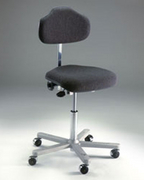
A chair should not be moved between workstations. Poor chair selection can undo all the positive effects of other ergonomic measures. The chair must match the user, adjust easily and provide support in various working positions. Backrest rake adjustment gives support to the lower back; depth adjustment affects sitting comfort.
Stand up work
For stand up work the work surface should measure 75 to 110 cm (29.52”-43.30”) high, depending on worker height and manipulated parts size (smaller parts call for higher tabletops). One meter is an average working level. Again, adjust down 5 cm (1.96”) for women.
Height adjustment (allowing for posture changes) is useful if the size of manipulated objects will vary. Height adjustable tables are also recommended in multi-user situations (e.g. shift work). Motor tables speed the adjustment process.
Horizontal work area
To improve working postures in assembly work, the most-often used parts should be placed into the normal horizontal working area within workers sight, around 45 cm (17.71”). When working with both hands, the frontal area is even shorter, around 35 cm (13.77”). Avoid overly large or deep workbenches, since assembly work is most ergonomic when parts are accessible. Recommended sizes are between 600 x 1000 mm (23.62” x 39.37”) and 750 x 1500 mm (29.52” x 59.05”). Indented tables provide additional comfort, accessibility and an arm rest.
Vertical work area
The vertical work area can be fine-tuned with accessories. Height adjustable arms help keep parts accessible. To avoid wrist tension, keep all components within 15 cm (5.90”) above the work surface. Tilt bin rails forward to keep the wrist in a neutral position when picking up parts. Finding parts is easier this way, too.
Footrests
Footrests should be located on the floor. Both feet should fit; allow 30 x 40 cm (11.81” x 15.74”). Do not use footrests when chairs with wheels are present. Freestanding footrests allow leg movement and clearance. Surface and bottom elements should always be of non-slip materials. Manipulate pedals with the feet to adjust height and inclination. Incline should not exceed 30 degrees. Daily re-adjustment is recommended.
Lighting
Lighting’s effect on posture is often forgotten as part of ergonomics. Appropriate lighting ensures visual comfort and effective task performance. A task that demands a good eye for detail calls for a task specific lighting. For viewing of square objects, two lights will eliminate shadows.
An ergonomically designed workplace maximizes the use of available working area, ease of adjustment and comfortable movement. When these ergonomic designs are applied in the workplace, worker productivity increases and company profitability is improved.
These sound, tested and proven design concepts are the basis of Sovella®. To learn more about how Sovella can improve your work places please find us at www.sovella.us.

ESDA Device Stress Testing Certification
Ensure your ESD and latchup testing results are performed
by certified testing technicians/engineers.
Today's Integrated Circuits continue to get more complicated which leads to increased difficulty performing ESD and latchup testing on products. In addition, the ESD and latchup standards are updated frequently to keep up with changing technologies. The ESD Association has developed the online Device Stress Testing Certification program which is targeted to train technicians and/or engineers who are involved directly in the area of ESD/latchup testing or are direct customers of internal or external ESD and latchup labs.
|
ESD Association Device Stress Testing Certification Program A Winning Certification Program for Both You and Your Company! All Classes Online! |
|
Today's Integrated Circuits continue to get more complicated which leads to increased difficulty performing ESD and latchup testing on products. In addition, the ESD and latchup standards are updated frequently to keep up with changing technologies. The ESD Association has developed the online Device Stress Testing Certification program which is targeted to train technicians and/or engineers who are involved directly in the area of ESD/latchup testing or are direct customers of internal or external ESD and latchup labs.
|
The ESD Device Stress Testing Certification Program
The ESD Device Stress Testing Certification program requires the completion of ten, one hour, online courses; this is composed of eight required courses and a choice of two electives.
Required Courses:
- ESD Fundamentals I for Stress Testing
- ESD Fundamentals II for Stress Testing
- HBM & MM Testing Essentials
- CDM Testing Essentials
- Fundamentals of Failure Analysis
- Essentials for Controlling the ESD Work Area
- High Speed Digital ESD Waveform Measurements
- Advanced HBM - Dealing with Tester Parasitics, High Pin Count and Two Pin Testing
Electives:
- Fundamentals of System Level Testing
- HMM - System Level Testing of Components
- TLP Fundamentals - Understanding the Equipment Options and IV Data
- Latch-up Testing and Troubleshooting
Certification Renewal Class:
- ESD Stress Testing Standard Updates
Courses are $195 each - or - $1,755 for a bundle of ten
Register for the Device Stress Testing Certification ProgramEOS/ESD Symposium & Exhibits 2013 coming in September
|


|
|
Device Stress Testing Certification Program
|
|||||||||||||||||
ESD Training
|
|||||||||||||||||
|
|||||||||||||||||




ESDA Offers On-Line Professional Cerification Training
Three of the Required Ten Program Manager Courses are now offered online!

The ESD Association offers a professional certification for ESD control program managers. The program is intended for individuals who are involved in design ing, implementing, managing, and auditing ESD control programs in their facilities.
Cost: $195.00 per class, per attendee
Purchase a bundle of 10 online/On-demand courses
for $1,755.00 and Save $195.
Click here to register for one or more online/On-demand courses !
Electrostatic Calculations for the PrM and ESD Engineer
Part 1-On Demand
Part 2-On Demand
Part 3-August 23, 2012, 11:00 a.m. Eastern Time
Part 4-Sept 26, 2012, 11:00 a.m. Eastern Time
Course Description
This online tutorial is a four part series on Electrostatic Calculations. The material included is the same as is included in the full tutorial usually presented at the EOS/ESD Symposium or ESDA Regional Tutorials. The four parts focus on the basic calculations and techniques of use to the Program Manager and the ESD engineer. The content is at the introductory high school or college pre-calculus and introductory college physics level set in the context of electrostatic discharge and its effects. Each part also includes an additional review of the mathematics used in the practical calculations.
Taking all four parts of this online calculations class will fill the requirement for the full length calculations tutorial that is part of the ESDA Program Manager Certification curriculum. Details on the Professional Certification Programs offered by ESDA are on our website at www.esda.org/certification.html. The Calculations class is recommended to help prepare for the iNARTE ESD Engineer exam. For details visit www.esda.org/nartecert.html: Terry Welsher, Dangelmayer Associates, L.L.C. Leo G. Henry, ESD TLP Consultants, LLC
Taking all four parts of this online Calculations class will fill the requirement for the full length tutorial that is part of the ESDA Program Manager Certification curriculum. Details on the Professional Certification Programs offered by ESDA are on our website at www.esda.org/certification.html.
AIR IONIZATION: ISSUES AND ANSWERS FOR THE PROGRAM MANAGER
Part 1-Oct 4, 2012, 11:00 a.m. Eastern Time
Part 2-Oct 16, 2012, 11:00 a.m. Eastern Time
Part 3-Oct 25, 2012, 11:00 a.m. Eastern Time
Instructor: ARNOLD STEINMAN,
Electrostatics Consultant Electronics Workshop
Course Description
The primary method of static charge control is direct connection to ground for conductors, static dissipative materials, and personnel. But a complete static control program must also deal with isolated conductors, insulating materials, and moving personnel that cannot be grounded. Air ionization can neutralize the charge on insulated and isolated objects. It does this by charging the molecules of the gases in the surrounding air. Whatever charge is present on objects in the work area, it will be neutralized by attracting opposite polarity charges from the air. This webinar will present the information needed to use ionizers to solve problems caused by static charge. It is a basic course on ionizers, providing an introduction to their use, as well as advanced application information.
Taking all three parts of this online Ionization class will fill the requirement for the full length tutorial that is part of the ESDA Program Manager Certification curriculum. Details on the Professional Certification Programs offered by ESDA are on our website at www.esda.org/certification.html.
2011 ESDA Symposium is Coming to Anaheim This September
|
|
About the EOS/ESD Symposium |
|
Your gateway to learning about the latest technical innovations in the area of ESD. The Technical Program includes 52 outstanding papers, including 2 invited exchange papers, spread across 12 technical sessions covering hot topics in the categories of Advanced CMOS, Case Studies, High Voltage and RF ESD challenges, Device Physics and Modeling, ESD EDA tools, Factory and Materials, System Level ESD and ESD testing. A quick overview of the different technical sessions is presented below. |
|
Tutorials |
|
Education: The Symposium starts with a set of academic and professional certification Tutorials on Sunday and Monday, then continues on Thursday. All tutorial content was renewed by our distinguished instructors to reflect the latest research and application developments in the past year. 8 New and 10 Revised Tutorials will be offered in 2011
NEW · ESD Training for Internal Quality Auditors and Supplier Quality Engineers · Electrical Overstress (EOS) in Manufacturing and Test · Integrated ESD Device and Board Level Design · Hands-on ESD Measurements & Instruments-Uses and Pitfalls · Electrostatic Standards Overview - Outside of ESDA · Program Manager Curriculum Updates · ESD Design Using Parameterized Mixed-Mode Device and Circuit Analysis · Automated Process Packaging Issues REVISED · ESD On-Chip Protection in Advanced Technologies Part I · System Level ESD/EMI:Testing to IEC & Other Standards · ESD On-Chip Protection in Advanced Technologies Part II · Ionization Issues and Answers for the Program Manager · Mastering TLP Basics (Advanced Topics in TLP & VF-TLP Testing) · ESD Circuits · Cleanroom Considerations for the Program Manager · Electrostatic Calculations for the Program Manager and the ESD Engineer · Device Technology and Failure Analysis Overview · Determining the Impact of Static Control Methods |
|
Technical Sessions |
|
Science: The Technical Program will span Tuesday to Thursday with outstanding talks presenting on many hot topics related to the phenomena of static electricity, applications, and control methods. Over 50 papers will be presented on ESD topics such as:
|
|
Workshops |
|
Workshops are a place to share professional issues and experiences, find solutions or openly discuss ideas with supporters or critics. The program of workshops on Tuesday and Wednesday afternoon will provide you the forums to talk and comment, receive feedback and learn from colleagues in a 'no necktie' environment. Workshops will focus on:
2011 will offer a workshop format with no formal panel. Come to the workshops with enthusiasm and get working on your ESD issues! |
|
Exhibits |
|
Industry Exhibits, Generating new research challenges and offering new ESD products and services, our colleagues from many companies will be happy to meet you in the Exhibit Hall, starting with the Welcome Reception on Monday evening till the exhibits close on Wednesday afternoon. Use this unique opportunity to find the ESD product or service you have been looking for during the year or just talk to the professionals with hands-on experience on static control methods, evaluation techniques, ESD hardware and many other ESD business matters. 2011 will host a new DEMO Day for Exhibitors to share their products and services |